
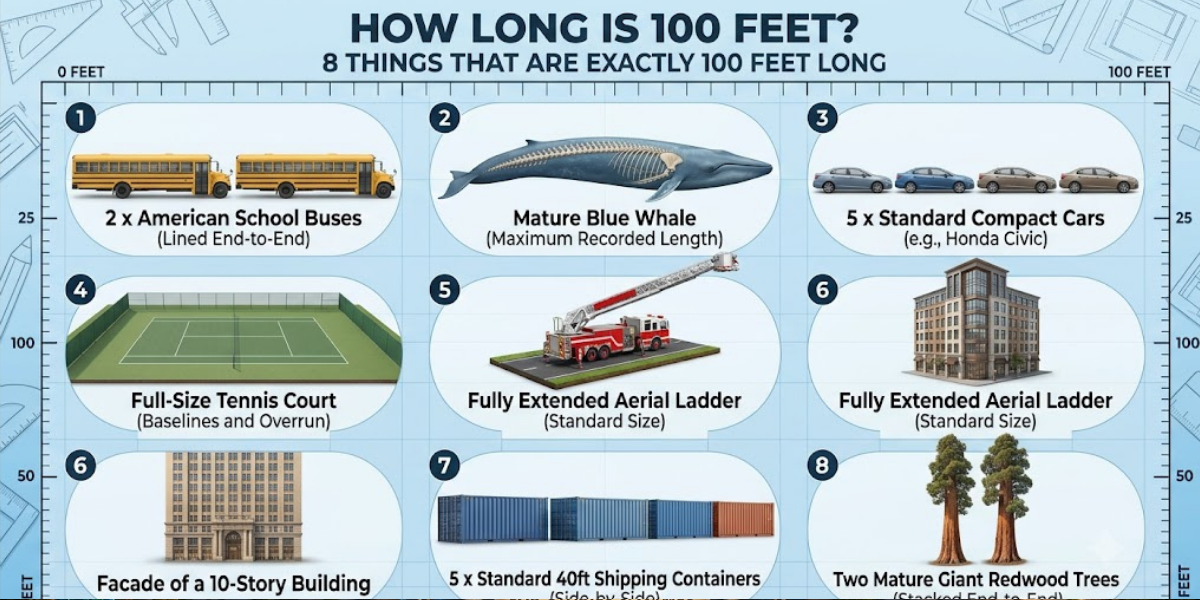
A measurement of 100 feet sounds simple, but it can be surprisingly difficult to picture. Most people can easily imagine 1 foot, 5 feet, or even 10 feet. Once a measurement reaches 100 feet, however, it becomes much harder to visualize without a familiar object for comparison.
So, how long is 100 feet?
100 feet is equal to 33.33 yards, 30.48 meters, 1,200 inches, or about 0.0189 miles. It is a substantial distance, but it is still short enough to walk in less than a minute at a normal pace.
The easiest way to understand 100 feet is by comparing it with familiar things.
In this guide, we’ll look at 8 things that are exactly 100 feet long or provide a useful real-world comparison for 100 feet. We’ll also cover how many steps are in 100 feet, how far you can walk, common conversions, and simple ways to measure the distance.
Quick Answer: How Long Is 100 Feet?
100 feet is a long distance for an everyday measurement.
Here are the most important conversions:
| Measurement | Equivalent |
|---|---|
| 100 feet | 100 ft |
| Inches | 1,200 inches |
| Yards | 33.33 yards |
| Meters | 30.48 meters |
| Centimeters | 3,048 cm |
| Millimeters | 30,480 mm |
| Kilometers | 0.03048 km |
| Miles | 0.01894 miles |
One of the easiest ways to visualize 100 feet is to imagine about 20 five-foot-tall people standing head-to-toe, around 7 average cars lined up, or one-third of an American football field.
You can also think of 100 feet as approximately 40 average walking steps, although the exact number depends on your stride length.
How Big Is 100 Feet in Real Life?
One hundred feet is longer than the average residential lot width but shorter than many large sports fields and commercial buildings.
If you’re standing at one end of a 100-foot distance, the opposite end will be clearly visible in most open spaces.
For example, imagine standing at one end of a parking lot and looking toward a point about 100 feet away. Depending on the surroundings, that could place you several parking spaces away or roughly the length of a small building.
Another useful comparison is a person’s height.
If someone is exactly 5 feet tall, you would need:
100 ÷ 5 = 20
So, 20 five-foot people standing head-to-toe would equal exactly 100 feet.
Of course, people aren’t normally arranged this way, but it gives you an easy mental picture.
How Long Is 100 Feet? 8 Things That Are Exactly 100 Feet Long
1. A Third of an American Football Field
An American football field is one of the easiest ways to visualize 100 feet.
The field of play is 100 yards long, excluding the end zones.
Because one yard equals 3 feet:
100 yards × 3 = 300 feet
Therefore, a standard 100-yard playing field is 300 feet long.
Now compare that with 100 feet:
100 ÷ 300 = 0.333
So, 100 feet is exactly one-third of the length of the field of play.
Imagine standing on the goal line and looking toward the opposite goal line. A distance of 100 feet would take you roughly one-third of the way across the field.
Why this is useful
Football fields have clearly marked yard lines, making them especially helpful for estimating long distances.
If you stand at one end and walk to around the 33-yard line, you’ve traveled approximately 100 feet.
That’s a much easier way to picture the measurement than simply thinking about the number 100.
2. About 6 to 7 Average Cars
Cars are another excellent everyday comparison.
A typical passenger car is approximately 14 to 16 feet long, although vehicles vary considerably.
If we use 15 feet as a convenient estimate:
100 ÷ 15 ≈ 6.67
That means about 6 to 7 average cars placed bumper-to-bumper would stretch approximately 100 feet.
Imagine parking six cars in a perfectly straight line, with each car touching the next.
Then add most of a seventh car.
That gives you a good visual representation of 100 feet.
What if you use larger vehicles?
SUVs, pickup trucks, and long vehicles can be 17 to 20 feet or more.
If each vehicle were 20 feet long:
20 × 5 = 100 feet
So, five 20-foot vehicles would span exactly 100 feet.
This is why the number of cars depends on the type of vehicle you’re using for comparison.
3. Twenty 5-Foot-Tall People
Here’s one of the simplest mathematical comparisons.
Imagine 20 people, each exactly 5 feet tall.
Place them head-to-toe in a perfectly straight line:
20 × 5 = 100 feet
So, 20 five-foot-tall people would create a line exactly 100 feet long.
This isn’t how people normally stand, of course, but it gives you a surprisingly useful mental image.
If you’re around 5 feet tall yourself, you can think of 20 versions of yourself lying end-to-end.
If you’re 6 feet tall, you would need fewer people:
100 ÷ 6 ≈ 16.7
So approximately 17 six-foot-tall people would span 100 feet.
A quick people comparison
- 10 people × 5 feet = 50 feet
- 20 people × 5 feet = 100 feet
- 25 people × 4 feet = 100 feet
- About 17 people × 6 feet ≈ 100 feet
This makes human height a simple way to understand large distances.
4. Two Tennis Courts Placed End to End
A standard tennis court is 78 feet long.
If you place two tennis courts end-to-end:
78 + 78 = 156 feet
That means two full tennis courts are considerably longer than 100 feet.
Instead, imagine traveling from one baseline toward the far end of the second court. The first court alone is already close to 80 feet.
You would need another 22 feet to reach 100 feet.
So, a tennis court provides an excellent visual starting point.
A simple tennis comparison
A standard tennis court:
78 feet long
A 100-foot distance:
100 feet long
Difference:
22 feet
That means 100 feet is about 28% longer than a tennis court.
If you’ve ever stood on a tennis court, imagine extending its length by another 22 feet.
That’s approximately 100 feet.
5. A 100-Foot Measuring Tape
This one is obvious but extremely useful: a 100-foot measuring tape gives you an exact representation of the distance.
Unlike comparisons based on cars, people, or buildings, a measuring tape is specifically designed to measure the distance.
A 100-foot tape is commonly used for:
- Construction
- Landscaping
- Property measurements
- Sports fields
- Fencing projects
- Outdoor projects
- Surveying
- Home improvement
If you have one available, extending it fully gives you exactly 100 feet.
Breaking the tape into sections
You can also think of 100 feet as:
10 × 10 feet
or:
4 × 25 feet
or:
2 × 50 feet
This makes it easier to estimate the distance if you don’t have a full 100-foot tape.
For example, four 25-foot lengths placed end-to-end equal exactly 100 feet.
6. About 7 School Buses
A full-size school bus can be around 35 to 45 feet long, depending on the model.
Because bus lengths vary, there isn’t one exact number of buses that always equals 100 feet.
But if you use a 40-foot school bus as a convenient reference:
40 × 2 = 80 feet
Two buses would be about 80 feet long.
You would need another 20 feet to reach 100 feet.
So, two and a half 40-foot buses would equal 100 feet.
Why school buses are useful
School buses are much larger than everyday cars, so they’re an easy way to appreciate the scale of 100 feet.
Imagine two buses parked bumper-to-bumper.
Now imagine another half-bus added behind them.
That gives you approximately 100 feet.
The exact result will vary according to the actual bus length, but it provides a useful visual comparison.
7. A Long Commercial or Industrial Building
Many commercial and industrial buildings can easily reach 100 feet in length.
For example, imagine a rectangular warehouse measuring:
100 feet long × 40 feet wide
Standing at one end and looking toward the opposite end would give you a good sense of how far 100 feet is.
A building that is 100 feet long may not sound enormous on paper, but it can look quite large when you’re standing outside it.
Buildings that may reach 100 feet
Depending on their design, some of the following structures can be around 100 feet long:
- Warehouses
- Schools
- Retail stores
- Workshops
- Agricultural buildings
- Community centers
- Commercial facilities
- Industrial buildings
Building dimensions vary widely, so these should be treated as examples rather than universal measurements.
A useful mental picture
Imagine walking from one end of a long warehouse to the other.
If the building is exactly 100 feet long, you’ve just traveled 100 feet.
This can make the measurement much easier to visualize than looking at a number on a blueprint.
8. About 40 Average Walking Steps
Walking is one of the easiest ways to experience 100 feet yourself.
The number of steps depends on your stride length.
If your average stride is approximately 2.5 feet, then:
100 ÷ 2.5 = 40 steps
So, you would need about 40 steps to walk 100 feet.
Someone with a shorter stride might need more steps, while someone with a longer stride might need fewer.
Estimated steps for 100 feet
| Approximate stride | Steps for 100 feet |
| 2 feet | 50 steps |
| 2.5 feet | 40 steps |
| 3 feet | 33 steps |
| 3.5 feet | 29 steps |
| 4 feet | 25 steps |
This makes counting steps a convenient way to estimate 100 feet when you don’t have a measuring tool.
Try it yourself
Find a straight, open area.
Start at one point and count approximately 40 normal steps.
If your stride is close to 2.5 feet, you’ll have traveled around 100 feet.
For a more accurate result, measure your average stride first and use the formula:
100 ÷ your stride length = approximate number of steps
How Long Does It Take to Walk 100 Feet?
For most people, walking 100 feet takes only a short amount of time.
A normal walking speed is around 3 miles per hour, although actual speeds vary.
At that pace, 100 feet takes roughly 20–25 seconds.
Someone walking quickly may cover the distance faster, while a slower walker may take longer.
Your walking time can also change because of:
- Hills
- Stairs
- Crowded areas
- Uneven surfaces
- Weather
- Walking speed
- Obstacles
Still, thinking of 100 feet as a distance you can walk in well under a minute gives you a useful sense of scale.
How Many Steps Are in 100 Feet?
There is no single answer because everyone’s stride is different.
For an average stride of approximately 2.5 feet:
100 ÷ 2.5 = 40 steps
Therefore, 100 feet is roughly 40 steps for that person.
Here are some examples:
- 2-foot stride → 50 steps
- 2.5-foot stride → 40 steps
- 3-foot stride → about 33 steps
- 3.5-foot stride → about 29 steps
- 4-foot stride → 25 steps
The best way to calculate your personal number is to measure how far you travel over several normal steps.
How Long Is 100 Feet in Meters?
If you use the metric system, the conversion is simple.
1 foot = 0.3048 meters
Therefore:
100 × 0.3048 = 30.48 meters
So:
100 feet = 30.48 meters
This means 100 feet is slightly longer than 30 meters.
A 30-meter distance is often easier to imagine if you’re familiar with metric measurements.
How Long Is 100 Feet in Yards?
There are 3 feet in 1 yard.
Therefore:
100 ÷ 3 = 33.333 yards
So:
100 feet ≈ 33.33 yards
This means 100 feet is approximately one-third of a 100-yard football field.
How Many Inches Are in 100 Feet?
Since there are 12 inches in every foot:
100 × 12 = 1,200 inches
Therefore:
100 feet = 1,200 inches
This is an exact conversion.
Although imagining 1,200 inches isn’t particularly useful for visualizing the distance, it can be helpful when working with measurements in construction, engineering, or other projects.
How Many Centimeters Are in 100 Feet?
One foot equals 30.48 centimeters.
Therefore:
100 × 30.48 = 3,048 centimeters
So:
100 feet = 3,048 centimeters
You can also express this as:
30.48 meters = 3,048 centimeters
How Many Millimeters Are in 100 Feet?
One meter contains 1,000 millimeters.
Since 100 feet equals 30.48 meters:
30.48 × 1,000 = 30,480 millimeters
Therefore:
100 feet = 30,480 millimeters
How Many Miles Is 100 Feet?
One mile contains 5,280 feet.
Therefore:
100 ÷ 5,280 ≈ 0.01894 miles
So:
100 feet ≈ 0.0189 miles
This means 100 feet is only about 1.9% of one mile.
To travel one mile, you would need to cover 52.8 distances of 100 feet.
That’s a useful reminder that a mile is much longer than 100 feet.
How Far Is 100 Feet Compared With 50 Feet?
The easiest comparison is to double 50 feet.
50 × 2 = 100 feet
Therefore, 100 feet is exactly twice as long as 50 feet.
If you can visualize a 50-foot distance, simply imagine placing another identical 50-foot section directly after it.
Together, they make 100 feet.
This is especially useful for estimating distances in yards, gardens, construction sites, and large room
How Far Is 100 Feet Compared With 200 Feet?
This comparison is even simpler.
100 + 100 = 200 feet
So, 100 feet is exactly half of 200 feet.
If you recently imagined 200 feet as two 100-foot sections, you can now picture 100 feet as just one of those sections.
For example:
- 50 feet = half of 100 feet
- 100 feet = one full section
- 200 feet = two 100-foot sections
- 300 feet = three 100-foot sections
Breaking large measurements into equal pieces is an easy way to build a mental scale.
100 Feet Compared With a Football Field
An American football field’s field of play is 100 yards long.
Since one yard equals 3 feet:
100 yards = 300 feet
Therefore:
100 feet = one-third of the field of play
This is one of the strongest visual comparisons for 100 feet.
If you stand on a football field, imagine the entire field divided into three equal sections.
One of those sections would be approximately 100 feet long.
The complete field, including both 10-yard end zones, measures 120 yards or 360 feet.
So, 100 feet is a little less than one-third of the complete field from end zone to end zone.
100 Feet Compared With a Tennis Court
A standard tennis court is 78 feet long.
Therefore:
100 − 78 = 22 feet
A 100-foot distance is 22 feet longer than a tennis court.
This makes a tennis court another helpful visual reference.
If you know what it feels like to stand at one baseline and look toward the opposite baseline, imagine extending that distance by another 22 feet.
You would then have approximately 100 feet.
100 Feet Compared With a Basketball Court
A standard NBA basketball court is 94 feet long.
That means a 100-foot distance is only:
100 − 94 = 6 feet
longer than an NBA court.
So, if you are familiar with professional basketball, imagine the length of the court from baseline to baseline.
Then add about 6 feet.
That gives you approximately 100 feet.
This is one of the closest sports-related comparisons available.
What Does 100 Feet Look Like?
The appearance of 100 feet depends heavily on where you are.
In an open field, 100 feet may look like a moderate distance.
In a narrow hallway or long building, it can feel much farther because the surrounding walls emphasize the distance.
In a parking lot, it might span several vehicles.
On a sports field, it may correspond to a clearly marked section.
In an open area
You can usually see the entire 100-foot distance easily.
In a parking lot
About six or seven average cars could fit bumper-to-bumper along the distance.
On a football field
It represents one-third of the 100-yard field of play.
In a building
A 100-foot-long structure can feel surprisingly large when viewed from inside.
How to Measure 100 Feet Without a Measuring Tape
You don’t always need professional equipment to estimate 100 feet.
Here are several simple methods.
1. Count Your Steps
If your stride is approximately 2.5 feet, take about 40 normal steps.
This gives you a rough estimate of 100 feet.
2. Use a Measuring Wheel
A measuring wheel is more accurate than counting steps and is useful for yards, driveways, lawns, construction areas, and other large spaces.
3. Use a Known Distance
If you know the length of a nearby object or space, use it as a reference.
For example, an NBA basketball court is 94 feet long, which is very close to 100 feet.
4. Use a Football Field
If you’re standing on a properly marked football field, use the yard lines.
Approximately 33.33 yards equals 100 feet.
5. Use a 100-Foot Tape
For the highest practical accuracy, use a measuring tape designed for long distances.
100 Feet in Different Units
Here is a quick reference table:
| Unit | 100 Feet Equals |
| Inches | 1,200 |
| Feet | 100 |
| Yards | 33.33 |
| Meters | 30.48 |
| Centimeters | 3,048 |
| Millimeters | 30,480 |
| Kilometers | 0.03048 |
| Miles | 0.01894 |
These conversions are useful when you’re working with different measurement systems.
Is 100 Feet a Long Distance?
Yes, 100 feet is a fairly long everyday distance, although it is not especially large compared with distances such as a quarter-mile or one mile.
For perspective:
- 100 feet = 30.48 meters
- 200 feet = 60.96 meters
- 500 feet = 152.4 meters
- 1,000 feet = 304.8 meters
- 1 mile = 5,280 feet
A 100-foot distance is long enough to be noticeable but short enough to walk quickly.
Why Understanding 100 Feet Is Useful
Knowing what 100 feet looks like can help in many real-world situations.
Home Improvement
You may need to estimate the length of a driveway, fence, garden, or property boundary.
Landscaping
Large yards often require measurements in feet to determine fencing, irrigation, planting areas, and other features.
Construction
Builders and contractors regularly work with measurements in feet.
Sports
Many athletic facilities use feet and yards to describe distances and dimensions.
Property Planning
Understanding 100 feet can help you estimate how much space a building, road, or outdoor feature will occupy.
Everyday Estimation
Even if you don’t regularly work with measurements, having a mental picture of 100 feet makes it easier to estimate distances around you.
Frequently Asked Questions About 100 Feet
How long is 100 feet?
100 feet is 30.48 meters, 33.33 yards, 1,200 inches, and approximately 0.01894 miles.
How many yards are in 100 feet?
There are approximately 33.33 yards in 100 feet.
How many meters are in 100 feet?
There are exactly 30.48 meters in 100 feet.
How many inches are in 100 feet?
There are exactly 1,200 inches in 100 feet.
How many steps are 100 feet?
For someone with a 2.5-foot stride, 100 feet is approximately 40 steps. The actual number depends on your stride length.
How long does it take to walk 100 feet?
At a normal walking pace, most people can cover 100 feet in roughly 20–25 seconds.
Is 100 feet one-third of a football field?
Yes. The 100-yard field of play is 300 feet long, so 100 feet is exactly one-third of its length.
How many cars fit into 100 feet?
Using an average car length of about 15 feet, approximately 6 to 7 cars could fit bumper-to-bumper across 100 feet.
How many people make 100 feet?
If each person is exactly 5 feet tall and they are placed head-to-toe, 20 people would equal exactly 100 feet.
Is 100 feet longer than a basketball court?
An NBA basketball court is 94 feet long, so 100 feet is approximately 6 feet longer.
Final Thoughts
So, how long is 100 feet?
The exact answer is simple:
100 feet = 1,200 inches = 33.33 yards = 30.48 meters = 3,048 centimeters = approximately 0.01894 miles.
But these numbers don’t always make the distance easy to visualize.
That’s why real-world comparisons are so useful.
You can picture 100 feet as:
- One-third of an American football field
- About 6–7 average cars lined up
- 20 five-foot-tall people standing head-to-toe
- About two and a half 40-foot school buses
- A distance slightly longer than an NBA basketball court
- About 40 walking steps for someone with a 2.5-foot stride
- Approximately 30.48 meters
- The length of a large commercial or industrial building
Once you connect the measurement to objects and places you already know, 100 feet becomes much easier to understand.
The next time you hear that something is 100 feet away or 100 feet long, you can picture roughly one-third of a football field, a line of several cars, or about 40 ordinary walking steps.
That’s what makes real-world comparisons so useful: they turn an abstract number into something you can actually see in your mind.
Leave a Reply