
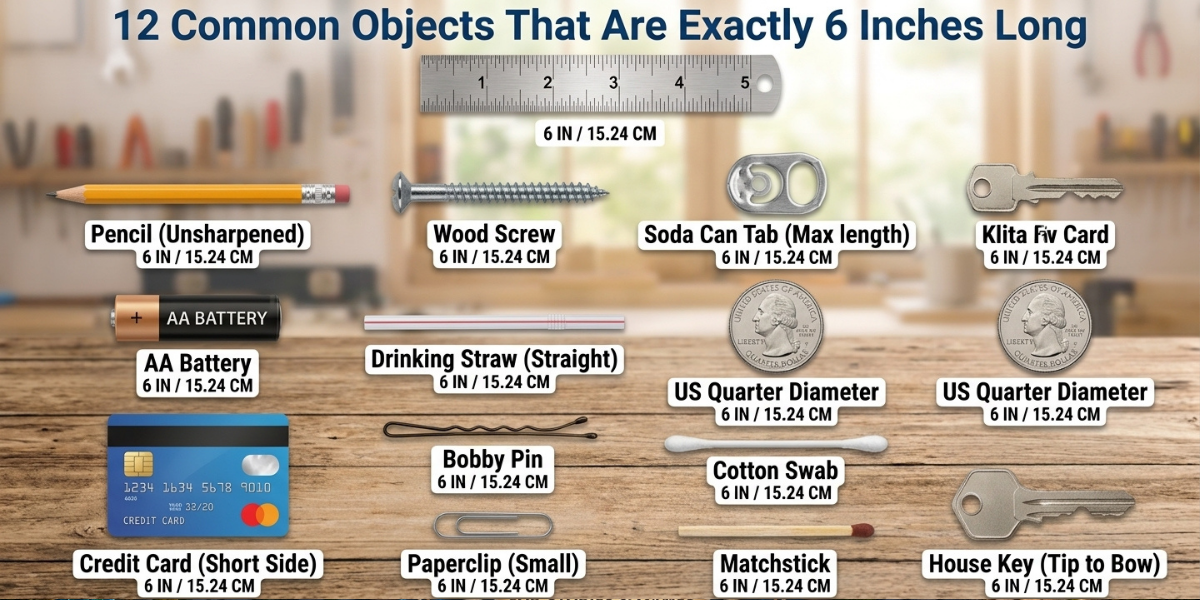
Six inches is a common measurement, but it can be surprisingly difficult to picture when you do not have a ruler nearby. You may understand that it is half a foot, but knowing the number alone does not always help you visualize the actual size.
Fortunately, many everyday objects can help you understand what 6 inches looks like. Some are exactly 6 inches long, while others are very close and work well as visual references.
In this guide, we will look at 12 common objects that are 6 inches long or approximately 6 inches in one dimension. We will also cover the conversion from inches to centimeters, simple ways to measure 6 inches without a ruler, and practical examples that make this length easier to remember.
How Long Is 6 Inches?
6 inches equals exactly 15.24 centimeters.
It can also be converted into several other units:
- 6 inches = 15.24 centimeters
- 6 inches = 152.4 millimeters
- 6 inches = 0.5 feet
- 6 inches = 0.167 yards
- 6 inches = 0.1524 meters
The easiest conversion to remember is:
6 inches = 15.24 cm = half a foot
Because one foot contains 12 inches, six inches is exactly halfway between 0 and 12 inches.
This makes 6 inches a useful measurement for small tools, kitchen items, stationery, electronics, and other objects that need to be compact but still practical.
What Does 6 Inches Look Like?
So, what does 6 inches look like in real life?
One of the easiest ways to picture it is to think of a standard 6-inch ruler. The distance from one end to the 6-inch mark is exactly half the length of a traditional 12-inch ruler.
You can also compare 6 inches with familiar objects.
For example, a U.S. dollar bill is 6.14 inches long, which means it is only slightly longer than 6 inches. A standard 4 × 6 photograph has a side that is exactly 6 inches long. A typical 6-inch sandwich also provides an easy food-based reference.
These comparisons make it easier to build a mental picture.
12 Common Objects That Are 6 Inches Long
Before we begin, there is an important point to remember.
Not every everyday object is manufactured to exactly 6 inches. Some products are designed around this size, while others are simply close to it. For objects such as bananas, toothbrushes, pencils, phones, and kitchen utensils, measurements can vary.
If you need a precise measurement for a DIY project or another task where accuracy matters, use a ruler or measuring tape.
With that in mind, here are 12 useful examples.
1. A 6-Inch Ruler
A 6-inch ruler is the most obvious and accurate example.
Unlike everyday objects that may vary in size, a ruler is specifically designed to measure length. Compact 6-inch rulers are commonly used by students, artists, crafters, office workers, and anyone who needs a small measuring tool.
A 6-inch ruler is especially convenient because it can fit inside a pencil case, desk drawer, notebook, or small toolbox.
If you want to know exactly what 6 inches looks like, simply look at the distance from the ruler’s starting point to the 6-inch mark.
This is also a useful way to calibrate your visual memory. After looking at a 6-inch ruler several times, you may become better at estimating the measurement without one.
Length: Exactly 6 inches
2. A 4 × 6 Photograph
A standard 4 × 6 photograph is another excellent reference.
The photograph measures 4 inches on one side and 6 inches on the other.
This format is extremely common. You may find 4 × 6 photos in family albums, picture frames, storage boxes, photo printing services, and scrapbooks.
The longer edge gives you an exact 6-inch reference.
Because a photograph is flat and rectangular, it is also easy to compare with another object. Place an item along the long edge of the photograph and you can quickly see whether it is shorter, longer, or close to 6 inches.
Long side: Exactly 6 inches
3. A 6-Inch Sandwich
A standard 6-inch sandwich is one of the easiest food-related examples of this measurement.
Many sandwich shops use a 6-inch size as a standard portion. A Subway 6-inch sandwich, for example, is specifically marketed around that length.
This makes a sandwich a surprisingly useful visual reference.
If you are holding a 6-inch sandwich, the distance from one end of the bread to the other gives you a practical idea of how long 6 inches is.
Of course, bread can vary slightly during preparation, so it should not replace a ruler when exact measurements are required.
Still, it is a familiar object that makes the measurement easy to picture.
Length: Approximately 6 inches
4. A U.S. Dollar Bill
A U.S. dollar bill is slightly longer than 6 inches.
Its standard length is approximately 6.14 inches, making it one of the easiest objects to use when estimating 6 inches.
The difference is only 0.14 inches, so visually it is very close.
If you do not have a ruler but have a dollar bill, you can use it as a quick reference. Imagine a line slightly shorter than the full length of the bill. That distance is roughly 6 inches.
This example is particularly convenient because many people carry or have access to U.S. currency.
Length: 6.14 inches
Compared with 6 inches: 0.14 inches longer
5. A Standard Pencil
A traditional unsharpened pencil is often close to 6 inches long, although the exact length depends on the manufacturer and pencil style.
Pencils are another useful measurement reference because they are common in schools, offices, homes, and art supplies.
A new pencil is usually longer than a heavily used pencil because sharpening gradually reduces its length.
For that reason, a pencil should be considered an approximate 6-inch reference rather than an exact measuring tool.
If you place a pencil beside a ruler, you can see how close its length is to the 6-inch mark.
Approximate length: Around 6 inches
6. A Pocket Comb
A small pocket comb is often designed around the 6-inch range.
These combs are made to be long enough to style hair while remaining compact enough to carry in a pocket, bag, or grooming kit.
A straight pocket comb gives you a simple visual reference because its length is easy to compare with a ruler.
Some travel combs are shorter, while larger styling combs can be longer, so the exact size depends on the product.
If you have a comb that is close to 6 inches, it can become a handy mental reference.
Approximate length: About 6 inches
7. A Kitchen or Dinner Knife
Some kitchen and dinner knives have a blade or overall length close to 6 inches.
Short utility knives and certain table knives can fall into this range, although knife dimensions vary considerably depending on their design.
A 6-inch blade is long enough for many everyday cutting tasks while remaining relatively easy to control.
When comparing knives, be careful about whether the measurement refers to the blade length or the total length of the knife.
For example, a knife with a 6-inch blade will be considerably longer overall once the handle is included.
Example measurement: Around 6 inches
8. A Toothbrush
A standard adult toothbrush can be close to 6 inches long, although many models are somewhat longer.
Toothbrushes make useful visual references because their long, narrow shape gives you a clear idea of a 6-inch distance.
Travel toothbrushes may be shorter, while some full-size toothbrushes can reach 7 inches or more.
If you need an exact reference, measure your toothbrush instead of assuming every toothbrush is the same size.
Still, a toothbrush sitting on a bathroom counter can help you quickly visualize a length around 6 inches.
Approximate length: 6–7 inches
9. A Compact Smartphone
Some older or compact smartphones have body lengths close to 6 inches, making them useful visual references.
However, smartphones come in many different sizes. Some are under 6 inches long, while larger models can be significantly longer.
There is also another important detail: when manufacturers describe a smartphone screen as “6 inches,” they usually mean the diagonal screen measurement, not the physical height of the phone.
For example, a phone with a 6-inch screen is not necessarily 6 inches tall.
So, when using a smartphone to visualize 6 inches, always check the actual device dimensions.
Approximate size: Around 6 inches for some models
10. A Small Paperback Book
Some compact paperback books have a width or height close to 6 inches.
Book dimensions vary depending on the publisher, format, country, and edition. However, many smaller paperback editions are designed around dimensions that make them easy to carry and hold.
A small book is a useful example because you can see how 6 inches compares with the larger dimensions of a typical book.
If you have a paperback nearby, measure its shorter side. You may find that it is close to 6 inches.
Approximate dimension: Around 6 inches
11. A Small Banana
A small or medium banana can sometimes measure around 6 inches long.
Bananas are naturally variable, so this is not an exact measurement. Different varieties can have different lengths, and individual fruit can vary even within the same variety.
Still, a banana around 6 inches long provides a familiar household reference.
If you place a banana beside a ruler, you can see how close it comes to the 6-inch mark.
This is a good example of why everyday objects should be used for visual estimates rather than precise measurements.
Approximate length: Around 6 inches
12. A Small Pair of Craft Scissors
Some compact craft or office scissors have an overall length close to 6 inches.
These scissors are commonly used for paper, fabric, crafts, school projects, and light office work.
The measurement usually refers to the entire scissors from the tip of one blade to the end of the handle, rather than the blade alone.
Scissors come in many sizes, so not every pair will be 6 inches long.
However, a compact pair around this size provides a useful example of a 6-inch object.
Approximate overall length: Around 6 inches
Quick Comparison Table
Here is a simple overview of the 12 examples:
| Object | Approximate Measurement |
|---|---|
| 6-inch ruler | Exactly 6 inches |
| 4 × 6 photograph | Exactly 6 inches on long side |
| 6-inch sandwich | About 6 inches |
| U.S. dollar bill | 6.14 inches |
| Standard pencil | Around 6 inches |
| Pocket comb | Around 6 inches |
| Kitchen/dinner knife | Around 6 inches |
| Adult toothbrush | Around 6–7 inches |
| Compact smartphone | Varies, some near 6 inches |
| Small paperback book | Around 6 inches |
| Small banana | Around 6 inches |
| Craft scissors | Around 6 inches |
The first two examples are particularly useful if you need a known 6-inch reference. The other objects are better treated as approximate visual comparisons.
6 Inches Compared With Other Measurements
Understanding 6 inches becomes easier when you compare it with familiar lengths.
6 Inches Is Half a Foot
This is the simplest comparison.
Since:
1 foot = 12 inches
then:
6 inches = 0.5 feet
Imagine a standard 12-inch ruler. The 6-inch mark is exactly in the middle.
6 Inches Is 15.24 Centimeters
In the metric system:
6 inches = 15.24 cm
This means 6 inches is slightly more than 15 centimeters.
If you are more familiar with centimeters than inches, thinking of 6 inches as approximately 15.24 cm can make the measurement easier to understand.
6 Inches vs. 5 Inches
The difference is only 1 inch.
Five inches equals 12.7 centimeters, while 6 inches equals 15.24 centimeters.
That extra inch may seem small, but it represents a 20% increase in length compared with 5 inches.
6 Inches vs. 12 Inches
Six inches is exactly half of 12 inches.
This is one of the easiest mental comparisons because a standard foot contains 12 inches.
If you know what one foot looks like, simply imagine cutting that length in half.
How to Measure 6 Inches Without a Ruler
What if you need to estimate 6 inches but do not have a ruler?
There are several ways to make a reasonable estimate.
Use a Dollar Bill
A U.S. dollar bill is 6.14 inches long, so it is very close to 6 inches.
Place the object beside the bill and compare the lengths.
Remember that the dollar bill is slightly longer.
Use a 4 × 6 Photo
If you have a standard 4 × 6 photograph, its longer side is exactly 6 inches.
This is one of the most reliable household references.
Use Half of a Foot
If you know the approximate length of one foot, imagine half of it.
Six inches is exactly half a foot.
Use Your Hand
Your hand can provide a rough estimate, but it should not be considered an exact measuring tool.
For some adults, the distance from the base of the palm toward the middle-fingertip area may be close to 6 inches, but hand sizes vary significantly.
If you want to use your hand as a personal reference, measure it once with a ruler and remember the result.
Use a Smartphone
A smartphone can also help you estimate 6 inches if you know its actual dimensions.
Check the manufacturer’s specifications first. Do not assume that a phone with a “6-inch display” is physically 6 inches long.
Why Is 6 Inches Such a Common Measurements
Six inches is a useful size because it sits between very small and relatively large dimensions.
It is:
- Easy to hold
- Easy to carry
- Large enough for many practical tools
- Small enough for compact products
- Convenient for stationery
- Useful for kitchen utensils
- Common in packaging and product design
This makes 6 inches a practical measurement for manufacturers and designers.
A product that is around 6 inches long can often fit comfortably in a person’s hand, making it suitable for many everyday tasks.
Where You Might See 6-Inch Measurements
You may encounter 6-inch dimensions in more places than you realize.
Kitchen
Small knives, utensils, baking pans, and other kitchen products may use 6-inch dimensions.
Office
Rulers, pencils, scissors, notebooks, and other stationery products can fall around this size.
Photography
The 4 × 6 photo format uses a 6-inch long side.
Electronics
Some phones and portable devices use dimensions or screen measurements around the 6-inch range.
Personal Care
Toothbrushes, combs, grooming tools, and other personal-care products can be close to 6 inches.
Crafts
Scissors, rulers, craft sticks, and other supplies are often designed around convenient hand-held dimensions.
Why People Often Misjudge 6 Inches
It is surprisingly common to misjudge small measurements.
When someone hears “6 inches,” they may imagine something much smaller or much larger than the actual length.
The reason is simple: most people do not regularly measure objects with their hands.
Instead of remembering numbers alone, our brains tend to understand physical size through familiar objects and experiences.
That is why connecting 6 inches to a 4 × 6 photograph, dollar bill, ruler, or sandwich can make the measurement much easier to remember.
How to Remember 6 Inches Easily
You do not need to memorize a long list of objects.
Choose two or three strong references.
For example:
6 inches = long side of a 4 × 6 photo
6 inches ≈ length of a dollar bill
6 inches = half of a foot
These three comparisons are enough for most everyday situations.
Once you have a mental picture of these objects, you can estimate other objects more easily.
Is 6 Inches Considered Long or Short?
Six inches is generally considered a small-to-medium everyday length.
It is longer than a credit card, shorter than a standard sheet of paper, and exactly half the length of a 12-inch ruler.
Because it is easy to hold in one hand, many objects designed for personal use fall close to this size.
However, whether 6 inches feels “long” depends on what you are measuring.
For a pencil, it may be normal. For a shelf, it is very short. For a small electronic device, it may be fairly large.
Frequently Asked Questions
How long is 6 inches in centimeters?
6 inches equals 15.24 centimeters.
Is 6 inches half a foot?
Yes. One foot is 12 inches, so 6 inches is exactly half a foot.
What common object is exactly 6 inches long?
A 6-inch ruler is an exact reference. A standard 4 × 6 photograph also has a side measuring exactly 6 inches.
Is a dollar bill exactly 6 inches long?
No. A U.S. dollar bill is approximately 6.14 inches long, making it slightly longer than 6 inches.
What does 6 inches look like?
Six inches looks roughly like the long side of a 4 × 6 photograph or slightly less than the full length of a U.S. dollar bill.
Can I measure 6 inches with my hand?
You can estimate it, but hand sizes vary. For better accuracy, measure your hand first and use it as your personal reference.
How many millimeters are in 6 inches?
There are 152.4 millimeters in 6 inches.
Is 6 inches the same as 15 centimeters?
Not exactly. Six inches equals 15.24 centimeters, which is 0.24 cm longer than 15 centimeters.
Is a 6-inch phone actually 6 inches long?
Not necessarily. A phone advertised with a 6-inch display usually refers to the diagonal screen measurement, not the physical length of the phone.
What is 6 inches compared with a ruler?
Six inches is exactly half of a traditional 12-inch ruler.
Final Thoughts
Understanding how long 6 inches is becomes much easier when you connect the measurement with objects you already know.
A 6-inch ruler and the long side of a 4 × 6 photograph are two of the best exact references. A U.S. dollar bill, 6-inch sandwich, pencil, pocket comb, toothbrush, small book, banana, and craft scissors can also help you develop a visual estimate, although their actual sizes can vary.
The key measurement to remember is:
6 inches = 15.24 centimeters = half a foot.
So, the next time you see a product described as 6 inches long, imagine the long side of a 4 × 6 photograph or about the length of a dollar bill.
Once you have these everyday references in mind, you will have a much better idea of what 6 inches looks like without needing to reach for a ruler.
Leave a Reply